Buying Glasses Online Is Easier Than You Think (If You Know What to Do)
Five years ago, buying glasses online felt risky. Today, it is the preferred way for millions of people. The selection is wider, the prices are lower, and with AI-powered virtual try-on, you can see exactly how frames look on your face before ordering.
But if you have never done it before, the process can feel overwhelming. Frame sizes, lens types, bridge widths, temple lengths — what does it all mean?
This guide walks you through the entire process, step by step.
Step 1: Know Your Face Shape
This is the most important step, and most people skip it. Your face shape determines which frame shapes will look good on you — and which will not.
The six main face shapes are:

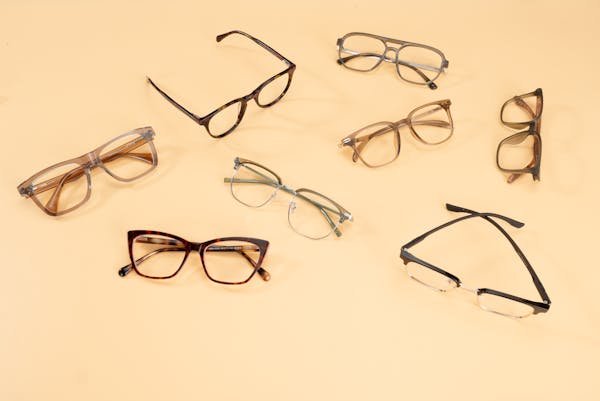
Compare different frame styles to find your perfect match
| Face Shape | Best Frames |
|---|---|
| Round | Rectangular, angular, browline |
| Square | Round, oval, aviator |
| Oval | Almost anything (most versatile) |
| Heart | Bottom-heavy, light-colored, oval |
| Oblong | Deep/tall, round, oversized |
| Diamond | Browline, cat-eye, oval |
How to find your face shape:
The easiest way is to use an AI tool. TryBestSpecs analyzes your photo and classifies your face shape using 400+ facial measurements — far more accurate than the "look in the mirror" method.
Alternatively, you can measure your face manually:
- Measure forehead width at the widest point
- Measure cheekbone width at the widest point
- Measure jawline from chin to below-ear, multiply by 2
- Measure face length from hairline to chin
Compare the ratios using the table above.
Step 2: Understand Frame Sizing
Frame sizes are usually printed on the inside of the temple arm (the piece that goes over your ear). The format looks like this:
52 □ 18 — 140
This means:
- 52 = Lens width (in mm) — the horizontal width of one lens
- 18 = Bridge width (in mm) — the distance between the two lenses
- 140 = Temple length (in mm) — the length of the arm from hinge to tip
How to Find Your Size
Method 1: Measure your current glasses If you already own a pair that fits well, check the numbers printed on the temple. Use these as your baseline.
Method 2: Measure your face
- Lens width: Measure the width of one eye from the inner corner to the outer edge of your face. Typical range: 40-60mm.
- Bridge width: Measure the distance between your two eyes at the narrowest point of your nose. Typical range: 14-24mm.
- Temple length: Measure from the hinge point (where glasses would sit on your ear) to about 1 inch past your ear. Typical range: 130-150mm.
Method 3: Use face photo analysis TryBestSpecs estimates frame sizing from your photo as part of the try-on process, so you do not need to measure manually.
Common Sizing Mistakes
- Frames too wide: They slide down your nose and look oversized
- Frames too narrow: They pinch your temples and leave red marks
- Bridge too wide: Glasses sit too low on your nose
- Bridge too narrow: Glasses pinch and leave marks on the nose
Step 3: Choose Frame Material
Frame material affects weight, durability, flexibility, and appearance:
Here's a quick reference for face shapes and their ideal frames:



Left to right: Round face → angular frames, Square face → round frames, Oval face → most frames work
Metal Frames
- Stainless steel — Lightweight, hypoallergenic, corrosion-resistant
- Titanium — Ultra-light, very strong, premium feel
- Monel — Common, affordable, nickel content may irritate sensitive skin
Plastic Frames
- Acetate — Rich colors, lightweight, adjustable with heat
- TR-90 — Flexible, durable, great for active lifestyles
- Nylon — Lightweight, strong, often used in sports frames
Mixed Materials
- Combination frames — Metal front with plastic temples, or vice versa
- Rimless — Only the lenses and bridge, minimal visual impact
- Semi-rimless — Frame on top, wire on the bottom
Choose based on your lifestyle:
- Office/Professional: Acetate or metal in classic colors
- Active/Sports: TR-90 or nylon for flexibility and durability
- Fashion/Statement: Acetate in bold colors, oversized styles
- Minimalist: Rimless or thin metal frames
Step 4: Pick the Right Lens Type
If you need prescription lenses, the type matters as much as the frame:
Single Vision
- One prescription across the entire lens
- For nearsightedness (myopia) or farsightedness (hyperopia)
- Most common type
Bifocal
- Two prescriptions in one lens — distance on top, reading on bottom
- Visible line separating the two zones
- For people who need both distance and reading correction
Progressive (No-Line Bifocal)
- Gradual transition from distance to near vision
- No visible line — looks like regular glasses
- Takes some getting used to; has a learning curve
Blue Light Filtering
- Blocks blue light from screens
- Reduces eye strain during extended computer use
- Can be combined with any prescription type
Photochromic (Transition)
- Lenses darken in sunlight, clear indoors
- Convenient for people who go in and out frequently
- Not as dark as dedicated sunglasses
Lens Coatings to Consider
- Anti-reflective (AR) — Reduces glare, especially for night driving and screen use. Highly recommended.
- Scratch-resistant — Extends lens life, especially for plastic lenses
- UV protection — Blocks harmful UV rays. Essential for outdoor use.
- Anti-fog — Prevents fogging with masks or temperature changes
Step 5: Use Virtual Try-On Before You Buy
This is where online shopping has caught up to — and surpassed — in-store shopping.
Instead of guessing from a product photo, use AI virtual try-on to see how frames look on your actual face:
- Upload a photo — Front-facing, good lighting, no existing glasses
- Get your face shape analysis — AI classifies your shape and skin tone
- See recommended frames — Filtered to shapes that match your geometry
- Try them on — Realistic rendering directly on your photo
- Compare side by side — See multiple frames on your face at once
- Save your favorites — Revisit and share with friends
TryBestSpecs does all of this in under 30 seconds, with no app download required.
Pro tip: Try at least 5-10 different frames before deciding. The first one that looks "okay" is rarely the one that looks best.
Step 6: Check the Return Policy
Before ordering, always check:
- Return window — How many days to return? 14-30 days is standard.
- Restocking fees — Some retailers charge for returns
- Prescription lens returns — Some do not accept returns on custom prescription lenses
- Exchange policy — Can you swap for a different frame without returning the lenses?
Step 7: Place Your Order
Once you have found your frame and know your prescription:
- Select your frame and color
- Enter your prescription — You will need: SPH (sphere), CYL (cylinder), AXIS, and PD (pupillary distance). Your optometrist provides most of these; PD can be measured at home with a ruler and mirror.
- Choose lens type and coatings
- Enter your shipping address
- Complete payment
What Is PD and Why Does It Matter?
Pupillary distance (PD) is the distance between the centers of your pupils, measured in millimeters. It ensures the optical center of the lens aligns with your pupils. Without a correct PD, your glasses can cause eye strain, headaches, or blurred vision.
How to measure PD at home:
- Stand 8 inches from a mirror
- Hold a ruler against your brow line
- Close your right eye, align the ruler's zero with the center of your left pupil
- Open your right eye, close your left eye
- Read the measurement at the center of your right pupil
- That number (typically 54-74mm) is your PD
Common Mistakes When Buying Glasses Online
❌ Choosing based only on how frames look on a model
The model's face shape is not yours. What looks great on them may look completely different on you. Always use virtual try-on.
❌ Ignoring frame size
A frame that is too wide or too narrow will not fit properly, no matter how good it looks.
❌ Forgetting about lens thickness
If you have a strong prescription (over ±4.00), choose a smaller frame. Larger lenses with strong prescriptions create thick, heavy edges.
❌ Skipping the PD measurement
Many people forget this. Without an accurate PD, your lenses will not be correctly positioned.
❌ Not checking the return policy
Always know the return policy before ordering, especially for prescription lenses.
❌ Rushing the decision
Take your time. Try multiple frames, compare them, ask friends for opinions. Save your top picks and come back the next day with fresh eyes.
Where to Start
If you are ready to buy glasses online, here is your action plan:
- → Find your face shape with TryBestSpecs (30 seconds)
- Use the face shape recommendations to narrow your frame choices
- Measure your current glasses or your face for sizing
- Get your prescription from your optometrist (including PD)
- Use virtual try-on to compare your top picks
- Check the return policy
- Order with confidence
The hardest part is choosing. AI virtual try-on makes it the easiest part.
Frequently Asked Questions
Can I really trust how glasses look online?
With AI virtual try-on, yes. The technology renders frames on your actual face with proper sizing, alignment, and lighting. It is far more reliable than guessing from a product photo.
What if my glasses do not fit when they arrive?
Most reputable online retailers offer free returns or exchanges within 14-30 days. Always check the policy before ordering.
Do I need my PD to order online?
Yes, for prescription lenses. Some retailers can measure it from a photo, but the most accurate method is measuring with a ruler at home or asking your optometrist.
Can I use virtual try-on for prescription sunglasses?
Yes. The same try-on process works for both prescription eyeglasses and sunglasses.
How much cheaper is buying glasses online?
Online glasses typically cost 50-80% less than comparable pairs at a brick-and-mortar store, depending on the retailer and frame brand.
Find Your Perfect Pair Today
Stop scrolling through endless product photos. See how glasses actually look on your face with AI virtual try-on.
→ Try Glasses On Your Face Now
Last updated: May 2026 Author: TryBestSpecs Team